
Every single day, students in India hear about ChatGPT, self-driving cars, smartphone assistants, smart robots, and recommendation systems on platforms like YouTube or Netflix. Because these modern tools look like magic, many young students naturally believe that Artificial Intelligence is automatically the most rewarding career of the future. However, this sudden popularity creates a major confusion among students and parents across the country.
Most students do not clearly understand what AI and Machine Learning actually mean, what technical skills are mandatory, whether heavy coding is required, or which degree courses they should choose after school. Many bright students even wonder if an average learner can enter this fast-growing technology field without being a mathematical genius.
The absolute truth is that Artificial Intelligence is not just a single job title or a simple computer course. Instead, it is a vast professional field with diverse career paths involving computer programming, mathematical reasoning, data handling, software development, research, and modern business automation tools.
You certainly do not need to be a born genius to build a successful Artificial Intelligence career, but you definitely need consistent practice, patience, and real practical skills. Whether you are a school student planning your future or a college student exploring fresh options, this guide will explain AI and ML careers, required skills, courses, learning roadmaps, job roles, and future scope in simple, relatable language.
What Are AI and ML, and How Do They Differ?
To understand this exciting field, students should first ask: what is Artificial Intelligence in everyday terms? Artificial Intelligence, or AI, simply refers to making computer systems smart enough to perform human-like tasks such as recognizing faces, understanding voice commands, or making smart decisions. On the other hand, Machine Learning, or ML, is a special branch inside AI that focuses on training computers to learn automatically from past data without being explicitly coded for every scenario.
Think of AI as an intelligent electronic house, while Machine Learning is the brain powering that smart house. For example, when your phone automatically sorts your vacation photos by location or person, Machine Learning algorithms are actively working behind the scenes.
Why AI and ML Careers Are Growing
Why are companies everywhere looking for skilled Machine Learning professionals today? Businesses generate massive amounts of digital data every second, and they need smart algorithms to analyze this data to predict customer habits, detect bank fraud, or automate customer support. This explosive demand makes a Machine Learning career highly promising for young minds who enjoy curiosity and logic.
If you enjoy solving puzzles or finding patterns in real-life problems, you should definitely consider an Artificial Intelligence career option. You do not need top ranks in every exam, but a genuine interest in computers and logical reasoning will give you a great starting advantage.
Essential Skills: Coding, Mathematics, and Data Handling
A common doubt among beginners is whether computer programming is strictly required for every AI role. The honest answer is yes, basic coding is necessary if you want to become a core Machine Learning engineer or software developer. However, you do not need to master dozens of complex coding languages right at the start. Python is the most popular programming language in the AI world because it is as simple to read as basic English sentences. Along with Python, beginners need to understand basic data storage concepts using SQL databases so they can easily pull and organize information.
How much mathematics do you actually need to learn Machine Learning skills effectively? You do not need high-level theoretical mathematics, but standard school-level algebra, basic probability, and statistics are essential. Statistics helps you understand data averages and patterns, while algebra helps computer models calculate correct answers.
Deep Learning, which imitates human brain neurons to process images and speech, relies heavily on these mathematical foundations. Similarly, modern Generative AI tools that create text or images use these exact mathematical rules to generate fresh content.
Choosing the Right Career Path
| Career/Skill | Best For | Main Work | Key Point |
| Machine Learning Engineer | Strong Coders | Builds predictive models using Python | High demand for core programming |
| Data Scientist | Math & Logic Lovers | Finds business patterns in large data | Focuses on statistics and insights |
| AI Product Specialist | Creative Thinkers | Guides AI tools for business needs | Requires less coding experience |
| Computer Vision Specialist | Visual Tech Enthusiasts | Trains models to process images | Used in medical imaging and cameras |
| Data Analyst | Analytical Beginners | Cleans data and creates visual reports | Excellent starting entry role |
As shown in the simple table above, different Artificial Intelligence career options require slightly different skill sets. Students should remember that they never need to learn all these technical skills at once on day one. Beginners should pick one clear area that matches their personal strengths and build basic confidence step by step. If you dislike heavy coding, exploring AI Career Without Coding options like product management, AI operations, or business data analysis is a smart strategy. Always align your natural interests with the practical skill demands of the industry.
AI Courses After 12th and Graduation Options
What educational degree should a student choose after completing school? After Class 12, students interested in technical development can pursue a B.Tech in Computer Science, Data Science, or Artificial Intelligence. Students coming from non-engineering streams can comfortably join B.Sc in Data Science, BCA, or B.Sc in Statistics.
After graduation, students can look for specialized AI and ML courses after graduation or pursue an M.Tech or MCA degree. Many reputed Indian universities now offer modern degree programs that combine fundamental computer science with practical AI training.
Apart from formal university degrees, online certifications and skill courses play a huge role in career growth. Reputed online learning platforms provide practical certifications in Python, data analysis, and Machine Learning basics. However, students must choose online courses carefully instead of blindly buying expensive packages. A course is only useful if it offers hands-on coding assignments and clear mentor feedback. Never fall for fake promotional advertisements that promise a complete job guarantee after a brief online course.
How a Beginner Can Start AI/ML
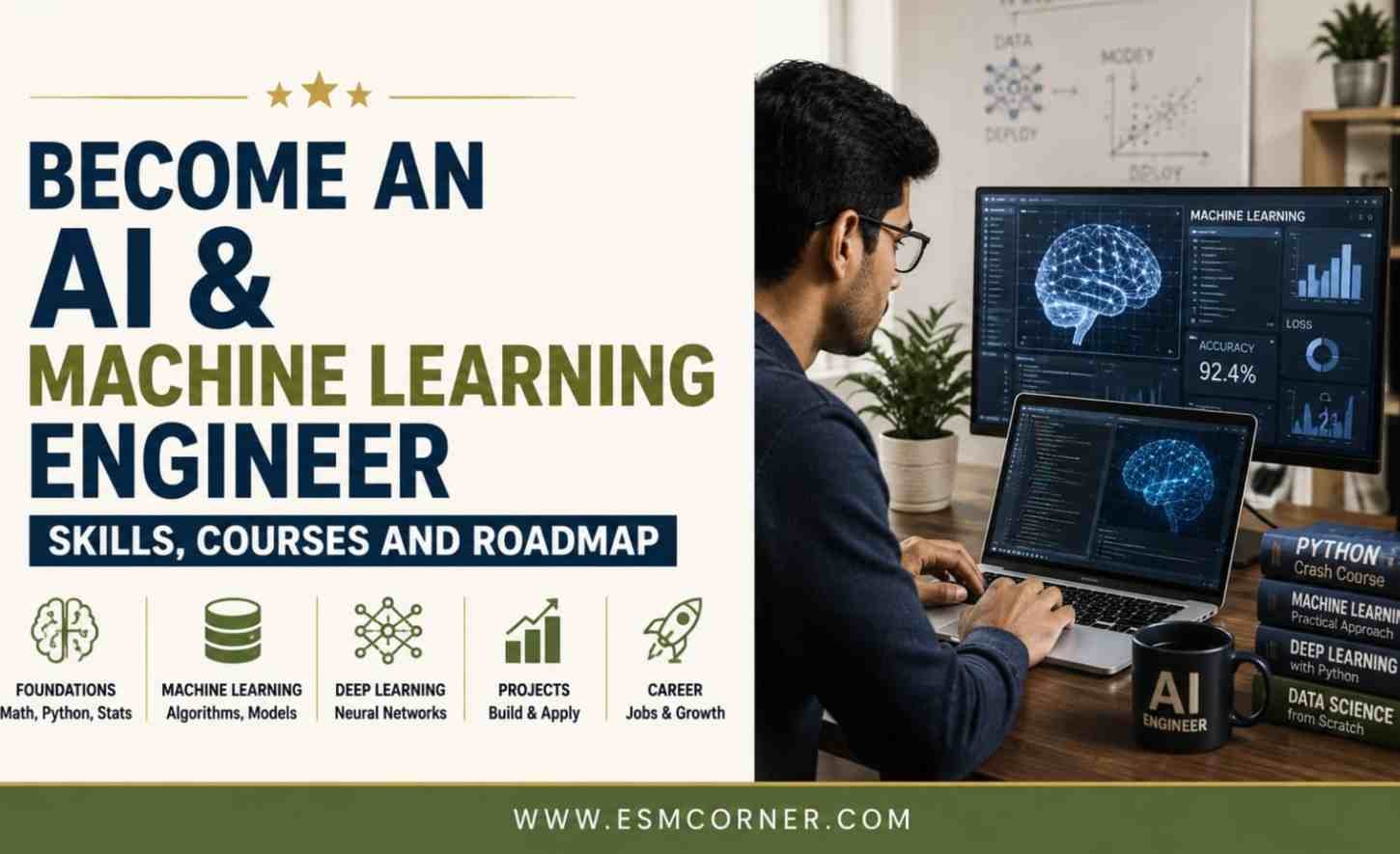
Here is a practical step-by-step roadmap for beginners entering the AI field:
- Understand basic computer concepts: Learn how software programs handle information.
- Learn basic Python: Practice writing simple scripts, functions, and logic loops.
- Learn mathematics and statistics fundamentals: Master school algebra, basic probability, and averages.
- Understand data: Learn to organize, clean, and query datasets using basic SQL.
- Learn basic Machine Learning: Master popular algorithms like linear regression and classification trees.
- Build small projects: Create simple applications like movie predictors or spam email filters.
- Learn advanced topics based on career interest: Explore neural networks or natural language processing tools.
- Create a portfolio: Upload your project code on GitHub and document your learning publicly.
- Apply for internships and entry-level opportunities: Gain practical industry exposure through entry-level roles.
Building an impressive project portfolio is far more valuable than collecting dozens of basic course certificates. Employers in the technology industry want to see proof of your practical problem-solving capabilities before offering an internship. You can showcase your projects on platforms like GitHub or write short articles explaining how you built your AI model.
Joining practical internships during college breaks helps you understand real business challenges and workplace requirements. Consistent daily learning and clear communication skills will always make your resume stand out to hiring managers.
Common Myths, Mistakes, and Non-Coding AI Careers
Many beginners make the mistake of rushing directly into advanced deep learning without mastering basic programming logic. Another frequent error is relying entirely on automated AI tools without understanding how underlying algorithms work. You must remember that using ChatGPT to write homework is completely different from building an actual AI model yourself.
Additionally, do not believe exaggerated rumors that AI will replace every human job overnight. Responsible AI development requires human creativity, domain understanding, critical thinking, and ethical decision-making that computers cannot replicate.
Conclusion
In conclusion, Artificial Intelligence and Machine Learning represent exciting career opportunities for young Indian students willing to put in genuine effort. However, students and parents must recognize that AI is not a magic shortcut to an effortless, high-paying career. True success in this competitive field requires mastering strong foundational basics, working on practical hands-on projects, developing logical problem-solving skills, and maintaining a mindset of continuous learning.
Instead of blindly collecting online certificates, focus on building practical tools that solve real human problems. Take time to explore different career paths, understand your natural strengths, and step confidently into the world of technology.
READ ALSO: CAREER OPTIONS AFTER 12TH SCIENCE (PCM) -ENGINEERING & BEYOND
Frequently Asked Questions
Q1.Is coding mandatory for a Machine Learning career?
Yes, core developer roles require programming knowledge, especially in Python. However, students who prefer non-coding options can explore AI product management, data visualization, AI operations, content strategy, or business analysis roles that focus on tool application rather than heavy code development.
Q2.Can a student from a non-engineering background learn AI?
Absolutely. Students from Commerce, Arts, or basic Science backgrounds can successfully enter this field. By starting with basic Python programming, elementary statistics, and practical data analysis tools, non-engineering students can gradually build strong Machine Learning skills through consistent effort.
Q3.Which programming language should I learn first for AI?
You should start with Python because of its easy syntax and massive ecosystem of AI libraries like NumPy and Pandas. Once you master Python fundamentals, learning data querying with SQL will make your transition into Machine Learning smooth and efficient.
Q4.Are expensive online certification courses necessary for AI jobs?
No, expensive courses are not mandatory. Many free high-quality tutorials, open-source documentation, and affordable university courses are available online. Employers prioritize practical project portfolios on GitHub and problem-solving abilities over expensive course completion certificates.
Q5.How much mathematics is required to start learning Machine Learning?
You need standard school-level mathematics, focusing mainly on linear algebra, probability, and basic statistics. Advanced mathematical concepts can be learned gradually as you progress toward complex Deep Learning algorithms and research-focused career paths.
Q6.What is the difference between Data Science and Machine Learning?
Data Science is a broad field focused on extracting meaningful insights from raw data using statistics and visualization. Machine Learning is a specific subset focused on building algorithms that allow software to learn and make predictions automatically.
Q7.Which degree options are best after Class 12 for an AI career?
Students can pursue B.Tech degrees in Computer Science, Data Science, or AI. Non-engineering students can opt for BCA, B.Sc in Computer Science, B.Sc in Statistics, or B.Sc in Data Science to build a solid academic foundation.
Q8.How can high school students prepare for an AI career early?
High school students should focus on strengthening their mathematics basics, improving logical reasoning, and learning basic Python coding. Building simple logic games or small data projects during school vacations gives students a massive practical head start.
For daily defence updates, government notifications, recruitment alerts, welfare schemes, career opportunities, education news, and other important announcements, join our WhatsApp Community. Click here to join our WhatsApp Group.