

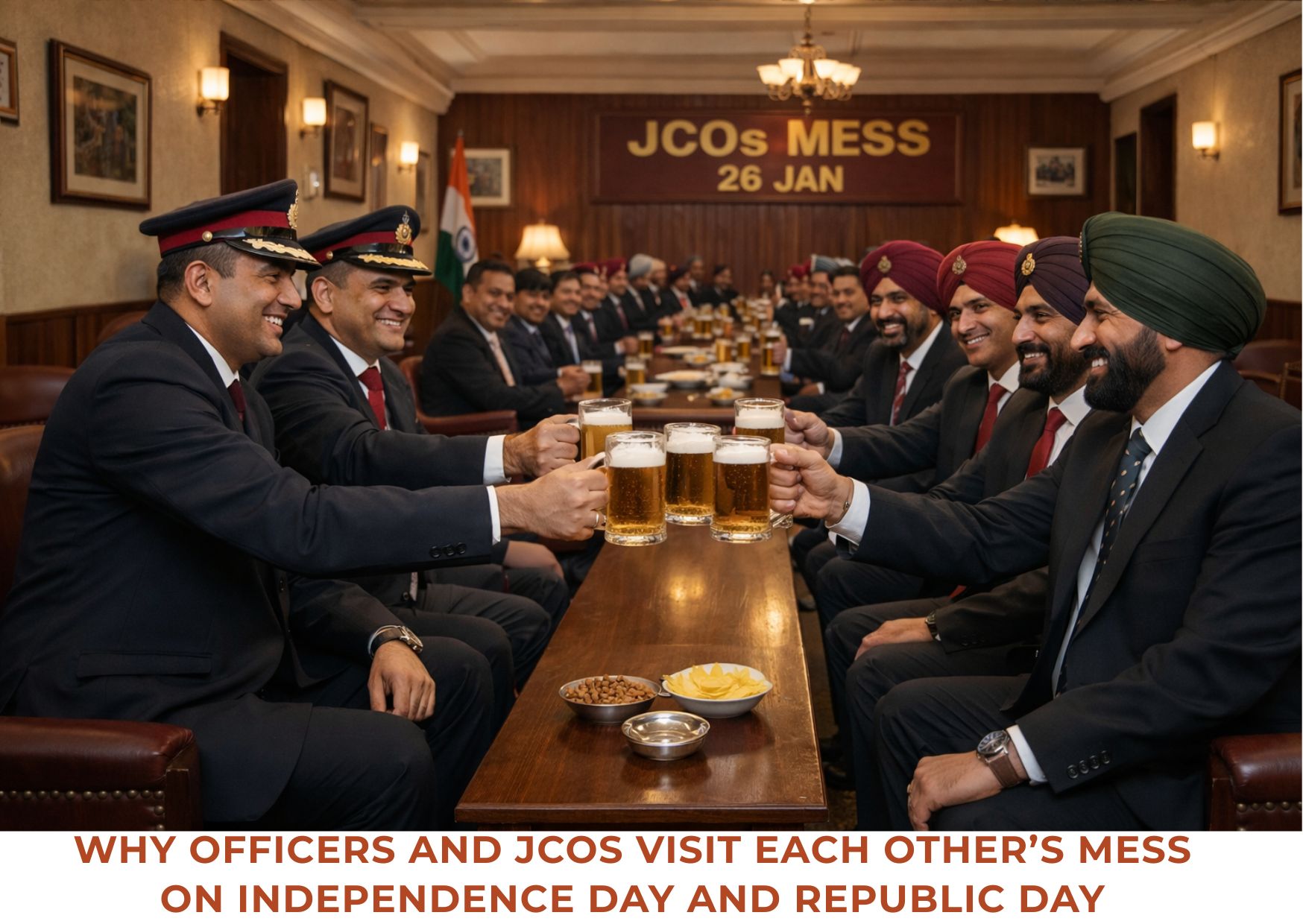
The Indian Army is known for its discipline, hierarchy, and strict chain of command. But beyond drills, ranks, and rules, the Army also believes in unity, mutual respect, and trust. Some traditions quietly but powerfully strengthen these values. One such unique tradition is the exchange of mess invitations between Officers and Junior Commissioned Officers (JCOs) on India’s two most important national days—Independence Day and Republic Day.
At first glance, this may seem like a simple social custom. In reality, it is a deeply meaningful practice that reflects the Indian Army’s ethos, history, and leadership philosophy.
The Importance of National Days in the Army
Both Independence Day (15 August) and Republic Day (26 January) are more than public holidays for soldiers. These days remind the Army why it exists—to protect the nation, its Constitution, and its people.
- Independence Day symbolises freedom from colonial rule.
- Republic Day symbolises equality, dignity, and the rule of law under the Constitution.
Celebrating these days together inside the Army sends a powerful message: the nation comes before rank.
Who Are JCOs and Why They Matter
Junior Commissioned Officers (JCOs) hold a special and unique position in the Indian Army. They are experienced soldiers promoted from the ranks based on merit, leadership, and years of service. JCOs include:
- Naib Subedar
- Subedar
- Subedar Major
They are gazetted officers and act as the bridge between officers and jawans. JCOs:
- Maintain discipline
- Look after troop welfare
- Conduct training
- Preserve traditions
- Advise officers on ground realities
Because of their experience and credibility, JCOs enjoy the trust of both officers and soldiers.
👉 Learn about grants, loans, and emergency relief provided by Kendriya Sainik Board.
Normal Mess System in the Army
To maintain discipline and professionalism, the Army has separate messes:
- Officers’ Mess
- JCO Mess (or JCO Club)
- Other Ranks Mess
The mess is not just a dining place—it is a social and cultural space. Normally, cross-rank social interaction inside messes is not allowed. That is why the exchange of invitations on national days is special and deliberate.
Why Officers Are Invited to the JCO Mess on Independence Day
This tradition began on 15 August 1947, India’s first Independence Day. At that time, many officers in the Army were still British, while JCOs were Indian soldiers who had risen through service.
On that historic day, the JCOs themselves invited officers to their mess to celebrate India’s freedom together. This was not ordered from above—it was a voluntary and emotional gesture by Indian soldiers who wanted unity in a newly free nation.
This act had deep meaning:
- It symbolised national ownership of the Army
- It showed confidence and dignity among Indian soldiers
- It reduced colonial-era class divisions
On Independence Day, JCOs host officers in their mess in a relaxed and friendly atmosphere. Rank formality is reduced, conversations are informal, and everyone celebrates the nation together. It builds trust and mutual understanding in a way that routine military life does not allow.
Why JCOs Are Invited to the Officers’ Mess on Republic Day
To balance this gesture and make respect mutual, General K. M. Cariappa, India’s first Indian Chief of Army Staff, introduced a reciprocal tradition.
He decided that:
- On Republic Day (26 January), officers would invite JCOs to the Officers’ Mess
Republic Day represents the Constitution, equality, and dignity of every citizen. Inviting JCOs to the Officers’ Mess on this day reflects these values within the Army.
During Republic Day gatherings:
- Officers and JCOs sit together
- Conversations are open and respectful
- Experience and service are honoured
This does not weaken discipline. Instead, it strengthens mutual trust, which is essential in combat and leadership.
👉 Click here to explore the Armed Forces Tribunal and learn how it provides speedy justice for serving and retired personnel.
Why This Exchange of Invitations Is Important
1. It Builds Trust
In operations, officers and JCOs depend on each other completely. Trust built in informal settings strengthens battlefield performance.
2. It Reduces Distance Between Ranks
Hierarchy is necessary, but emotional distance can be harmful. These traditions reduce that gap without breaking discipline.
3. It Strengthens Unit Cohesion
A unit that eats together, talks together, and respects each other fights better together.
4. It Recognises Experience
JCOs often have decades of service. These traditions acknowledge their wisdom and contribution.
5. It Reflects Indian Values
Indian culture respects elders, experience, and shared celebration. These traditions fit naturally with those values.

Connection With National Recognition
Around Independence Day and Republic Day, the nation announces:
- Gallantry awards
- Honorary ranks for deserving JCOs
The mess celebrations complement these honours by showing respect at unit level, not just on paper.
Why This Tradition Is Unique
In many foreign armies, messes remain strictly separated by rank. The Indian Army maintains discipline but also allows controlled and meaningful bonding.
This balance makes the Indian Army:
- More united
- More resilient
- More humane
👉 ALSO READ I 10 MUST-KNOW BENEFITS AND UPDATES FROM THE DIRECTORATE OF CANTEEN SERVICES IN 2026
Conclusion
The tradition of officers visiting the JCO Mess on Independence Day and JCOs visiting the Officers’ Mess on Republic Day is not about breaking hierarchy. It is about strengthening leadership, trust, and unity.
It reminds every soldier that while ranks may differ, the uniform, the mission, and the nation are the same.
This simple yet powerful tradition is one of the many reasons why the Indian Army remains disciplined, respected, and deeply connected at every level.
Q1. Why do officers visit the JCO Mess on Independence Day (15 August)?
A1. This tradition started from 15 August 1947 as a symbol of unity in the newly free Indian Army. Officers visiting the JCO Mess builds trust, respect, and bonding beyond rank.
Q2. Why do JCOs visit the Officers’ Mess on Republic Day (26 January)?
A2. Republic Day represents equality under the Constitution. Inviting JCOs to the Officers’ Mess reflects mutual respect and strengthens teamwork inside the unit.
Q3. Who introduced the Republic Day mess invitation tradition?
A3. The tradition of inviting JCOs to the Officers’ Mess on Republic Day was introduced by General K. M. Cariappa, India’s first Indian Chief of Army Staff.
Q4. Does this tradition break hierarchy or discipline in the Army?
A4. No. It happens only on special national days and remains fully disciplined. It improves officer–JCO understanding and strengthens unit cohesion.
Q5. What is the main purpose of officers and JCOs visiting each other’s mess?
A5. The main purpose is to build trust, reduce rank-distance, and promote unity. A stronger bond between officers and JCOs leads to better leadership and better performance in operations.



Very very good.Happy independent Day