


Every Monday, we try to bring stories that inspire people and remind us that life always offers new opportunities. Many times we believe that retirement is the end of an active journey. But some people prove that retirement can actually be the beginning of a completely new mission.
This week, we bring you the story of Gautam Thapa, a former Signaller of the Indian Army whose life reflects dedication, curiosity, and a deep desire to serve society. His journey from being a draughtsman in the Corps of Signals to becoming a supporter of organic farming, Ayurveda, and rural education is truly inspiring.
Even after leaving the Army, Gautam Thapa did not stop serving society. Instead, he found new ways to contribute to his Community. Today he is known not only as a veteran but also as someone who has worked hard to improve the lives of people around him, especially children in his village.
His story shows that a soldier’s spirit of service never really ends—it Simply finds new directions.
Early Life and Army Service
Gautam Thapa grew up in Kamlari village in Bakloh Cantt, Dalhousie in Himachal Pradesh. Like many young boys from small towns and villages, he had a strong desire to serve the nation. That dream became reality when he joined the Indian Army at the age of just 17.
He served in the Corps of Signals, one of the most important technical arms of the Indian Army, often known as the “Backbone of the Army.” It is also regarded as one of the most dedicated and disciplined corps of the Indian Army. The Corps of Signals is responsible for maintaining communication at all levels of the Army, ensuring that information flows smoothly from the highest headquarters to the units deployed on the ground. This communication is carried out through modern systems such as data networks, radio communication, and voice calls, which keep all formations and units connected and coordinated.
Whether during peace or military operations, the Signals Corps plays a crucial role in ensuring smooth coordination and effective functioning of the Army. Because of this vital responsibility, the Corps of Signals remains a key pillar that supports the operational strength of the Indian Army. 📡.
During his service in the Army, Gautam Thapa worked as a Draughtsman. In this role, he was responsible for preparing technical drawings, maps, layouts, and design plans that were essential for military planning, communication infrastructure, and operational organization. The work required a high level of precision, patience, concentration, and technical understanding, as even small details could be important for effective planning and execution.
Looking back at his Army days, Gautam Thapa often reflects on the values he learned during those years. “I always believed discipline and dedication could take you far,” he says.
During his 18 years of service as an NCO, Gautam Thapa not only carried out his responsibilities sincerely but also absorbed the deeper lessons that the Army teaches every soldier. Discipline became part of his daily life. He learned the importance of teamwork, leadership, and commitment to duty. These values later played a very important role in shaping his life after retirement.
Another remarkable thing about Gautam Thapa ’s Army life was his dedication to education. When he joined the Army, he had completed his 10+2 education. However, he never stopped learning.
While serving in the Army, he continued his studies and completed several academic qualifications including M.A. in English, M.A. in Public Administration, PGDCA, and B.Ed. Managing higher education while performing military duties is not easy, but Gautam Thapa believed that learning should never stop.
This habit of continuous learning eventually helped him explore many new paths later in life.
Searching for a New Direction After Retirement
When Gautam Thapa completed his service in the Army, he entered a new phase of life. Like many veterans, he began thinking about how he could continue contributing to society in a meaningful way.
Initially, he prepared for the State PCS (Public Civil Services) examination in Himachal Pradesh. His aim was not to gain power or privileges but to serve people through administration. He believed that working in civil services would allow him to help society in a structured way.
During this period, he was also selected for the post of Junior Engineer (Civil). However, due to certain circumstances, he decided not to join the position.
Later he started working with a multinational company (MNC) through a work-from-home arrangement. The job provided financial stability, but something inside him felt incomplete.
👉 how to prepare for a career in the corporate sector
Although the work was comfortable, Gautam Thapa felt that he wanted to do something more meaningful—something that connected him with people, nature, and society.
That inner search slowly guided him towards a new interest.

Discovering Ayurveda and the Importance of Natural Living
During this time, Gautam Thapa developed a strong interest in Ayurveda, the ancient Indian system of natural medicine and holistic health.
At first, it was simply curiosity. He began reading about herbal remedies, natural healing practices, and the principles of balanced living described in Ayurvedic texts. Slowly, his curiosity turned into genuine passion.
The more he learned, the more he realized how closely Ayurveda is connected with nature and lifestyle.
Gautam Thapa explains this realization very simply:
“Ayurveda taught me that true wellness comes from understanding nature and balance.”
This understanding began influencing his daily life. He started focusing more on natural food, healthy living, and preventive healthcare. Instead of depending only on modern medicines, he began exploring traditional ways of maintaining good health.
This interest in Ayurveda naturally led him toward organic farming, because healthy food and natural living go hand in hand.
Beginning the Journey of Organic Farming
Starting something new is never easy, especially when a person has no prior experience in that field. But Gautam Thapa approached farming the same way a soldier approaches a mission—with patience, determination, and willingness to learn.
He began on a very small scale. Initially, he started growing vegetables in a simple kitchen garden and also experimented with mushroom cultivation.
These early experiments helped him understand the basics of farming. He learned about soil, climate, natural fertilizers, and sustainable agricultural practices.
Gradually, his confidence grew. With time, the small garden expanded into a small mushroom and vegetable farm.
Today, Gautam Thapa grows fresh produce using organic methods. His farm supplies vegetables and mushrooms to the local community. What makes his initiative even more meaningful is that he focuses especially on people above the age of 50, encouraging them to consume healthy and natural food for better health.
His work shows that farming is not just about agriculture—it can also be a way of promoting healthier living in society.
A Mission to Improve Education
While Gautam Thapa was exploring farming and natural living, another concern began to occupy his thoughts—education in his village.
Like many government schools in rural areas of India, the local school was facing several challenges. Even though the government runs schemes such as Samagra Shiksha Abhiyan, Mid-Day Meal Scheme, and various infrastructure programs, the benefits sometimes take time to reach remote areas.
In many villages, schools still struggle with limited resources, outdated facilities, and lack of exposure for students.
When Gautam Thapa observed the situation closely, he noticed that the children were eager to learn. They had dreams and curiosity, but the school environment lacked the facilities needed to support their growth. This realization touched him deeply.
He believed strongly that education is the most powerful tool for changing society. If children receive the right guidance and environment, they can build a better future not only for themselves but also for their communities.
With this belief in mind, Gautam Thapa made an important decision. He decided to adopt the local government school and work towards improving it.
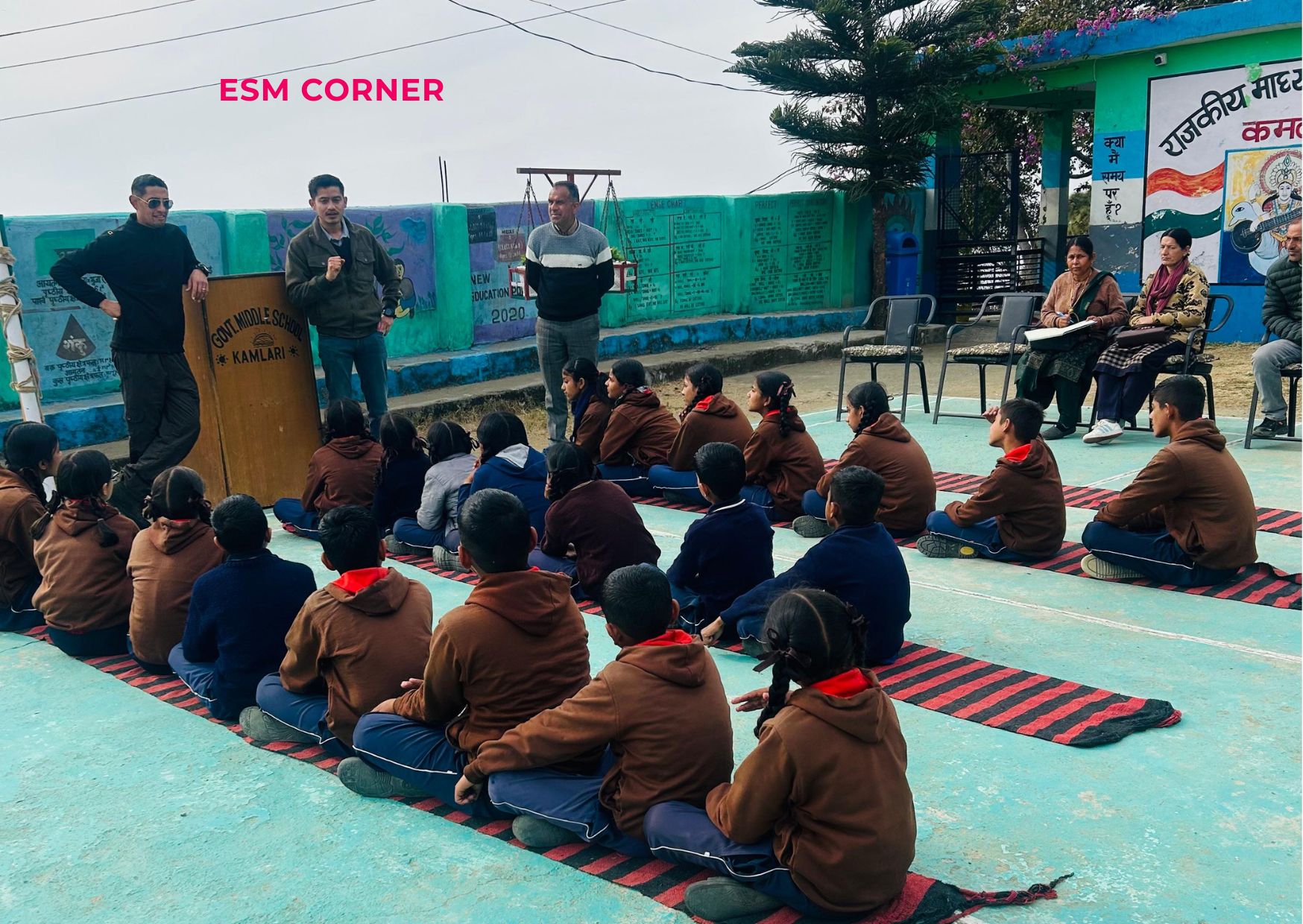
Transforming the School Environment
Drawing inspiration from the discipline and planning he learned in the Army, Gautam Thapa started working gradually to improve the school.
one of his first initiatives was the construction of a Maa Saraswati Temple within the school campus. Maa Saraswati is worshipped as the goddess of knowledge and wisdom, and the temple became a symbol of respect for learning.
Along with this, Gautam Thapa focused on improving the physical and academic environment of the school. Classrooms were upgraded so that students could study in a better atmosphere. A library was established to encourage children to develop reading habits. Access to books opened new windows of knowledge for students who had previously limited exposure.
Understanding the importance of technology in modern education, Gautam Thapa also arranged for computers to be installed in the laboratory. This step helped introduce students to digital learning and basic computer knowledge.
But Gautam Thapa believed that education should not be limited only to textbooks. He wanted children to grow as confident and creative individuals. For this reason, he introduced arts and crafts activities, extracurricular programs, and creative learning exercises. These activities allowed students to explore their talents and develop teamwork and confidence.
He also helped establish a proper inventory system so that school resources could be managed effectively. To improve safety and basic facilities, the school campus was equipped with CCTV cameras, and an RO water filtration system was installed to provide clean drinking water to students.
Looking ahead, Gautam Thapa is now working on developing a Smart Creative Lab. This facility is expected to help students learn through technology, innovation, and practical experimentation.
Overcoming Challenges
Transforming a school in a rural area is not an easy task. Gautam Thapa faced several challenges along the way. Arranging resources, coordinating with authorities, and encouraging the community to participate required patience and determination.
Government processes often take time, and long-term improvement in education requires continuous effort from many people.
However, Gautam Thapa ’s background as an Army veteran helped him gain the trust of the community. Slowly, villagers, teachers, and parents began supporting his efforts. Gradually, the school started changing.
Reflecting on his motivation, Gautam Thapa says: “I wanted to give these children what I consider a strong foundation for their future.”
He often recalls the words of his friend Mahesh Bhatt, whom he met during his service, who used to say that money is better utilised in creating life-changing experiences rather than simply accumulating materialistic things. This thought continues to inspire Gautam in his efforts to bring meaningful change to society. Today, his work has improved the learning environment for hundreds of students and encouraged the local community to take greater interest in education.
Commitment to Environmental Conservation
Apart from his work in education, farming, and community development, Gautam Thapa has also made a significant contribution towards protecting the environment. Since his retirement from the Army, he has been instrumental in planning and planting around 1,610 trees in and around his village and nearby areas. For Gautam, planting trees is not just about increasing greenery; it is about creating a healthier and more sustainable environment for future generations. He strongly believes that every tree planted today is a step toward a better tomorrow and a meaningful way of giving back to nature and society. 🌱🌳
A Soldier’s Spirit of Service
Gautam Thapa’s journey teaches us that the spirit of service learned in the armed forces does not end with retirement. Instead, it continues in different forms.
His life after the Army has been a combination of learning, experimentation, and community service. Whether it is promoting natural health through Ayurveda, encouraging sustainable farming, or improving rural education, his work reflects a deep commitment to society.
One of the most memorable moments of his Army life was when he was assigned photography duty and had the opportunity to meet the late President Dr. A. P. J. Abdul Kalam. Gautam Thapa spent around 30 days with him and even received a gift from the former President, a memory that continues to inspire him.
He also fondly remembers his friend Mahesh Chandra Bhatt, whom he first met during the SSB and later had the opportunity to serve with as a signaller. Gautam often shares that Bhatt’s dedication, humility, and positive outlook had a deep influence on him. Bhatt always believed that life should be about creating meaningful and life-changing experiences rather than merely accumulating material possessions. This thought stayed with Gautam and inspired him to think beyond conventional paths, motivating him to take initiatives that could bring real and lasting change to society.
⭐ Know an Inspiring Veteran?
Do you know a retired Armed Forces veteran who is doing something remarkable after retirement? Perhaps someone who has started a meaningful initiative, built a successful venture, secured a Class A or Class B government job, or is making a positive impact in society.
Their journey can inspire thousands of fellow veterans. If you know such a story, share it with us and we will publish it so the entire veteran community can learn and get inspired.
Let the community celebrate the inspiring work our veterans continue to do beyond the uniform.
Conclusion
The story of Gautam Thapa is a powerful reminder that life after retirement can be a new beginning rather than an ending.
From serving as a disciplined Army draughtsman to becoming an advocate of Ayurveda, organic farming, and education, Gautam Thapa has shown how one person’s determination can create meaningful change in society.
His journey encourages all of us—especially veterans—to keep learning, keep exploring, and continue serving the community in whatever way possible.
Stories like his remind us that the uniform may be removed, but the spirit of a soldier continues to guide a lifetime of service.

Join us on WhatsApp for daily updates




happy to be heard
A soldier’s dedication to improve the community through his acquired knowledge in service.
Keep doing Mr. Gautam Thapa