

Many pensioners, veterans, and even serving personnel often get confused between CPENGRAMS and CPGRAMS. Both are grievance redressal systems of the Government of India, and both are available on the same overall public grievance platform. Because of this, people frequently assume that both systems are the same or interchangeable.
In reality, CPENGRAMS and CPGRAMS serve very different purposes. Choosing the wrong platform can lead to delays, incorrect replies, or even closure of the grievance without proper resolution. For pensioners—especially defence pensioners—understanding this difference is extremely important.
This article explains, in simple language, what CPENGRAMS and CPGRAMS are, how they differ, and which one should be used in which situation.
1. Basic Purpose of the Two Platforms
The most fundamental difference lies in why these platforms exist.
- CPGRAMS (Centralised Public Grievance Redress and Monitoring System)
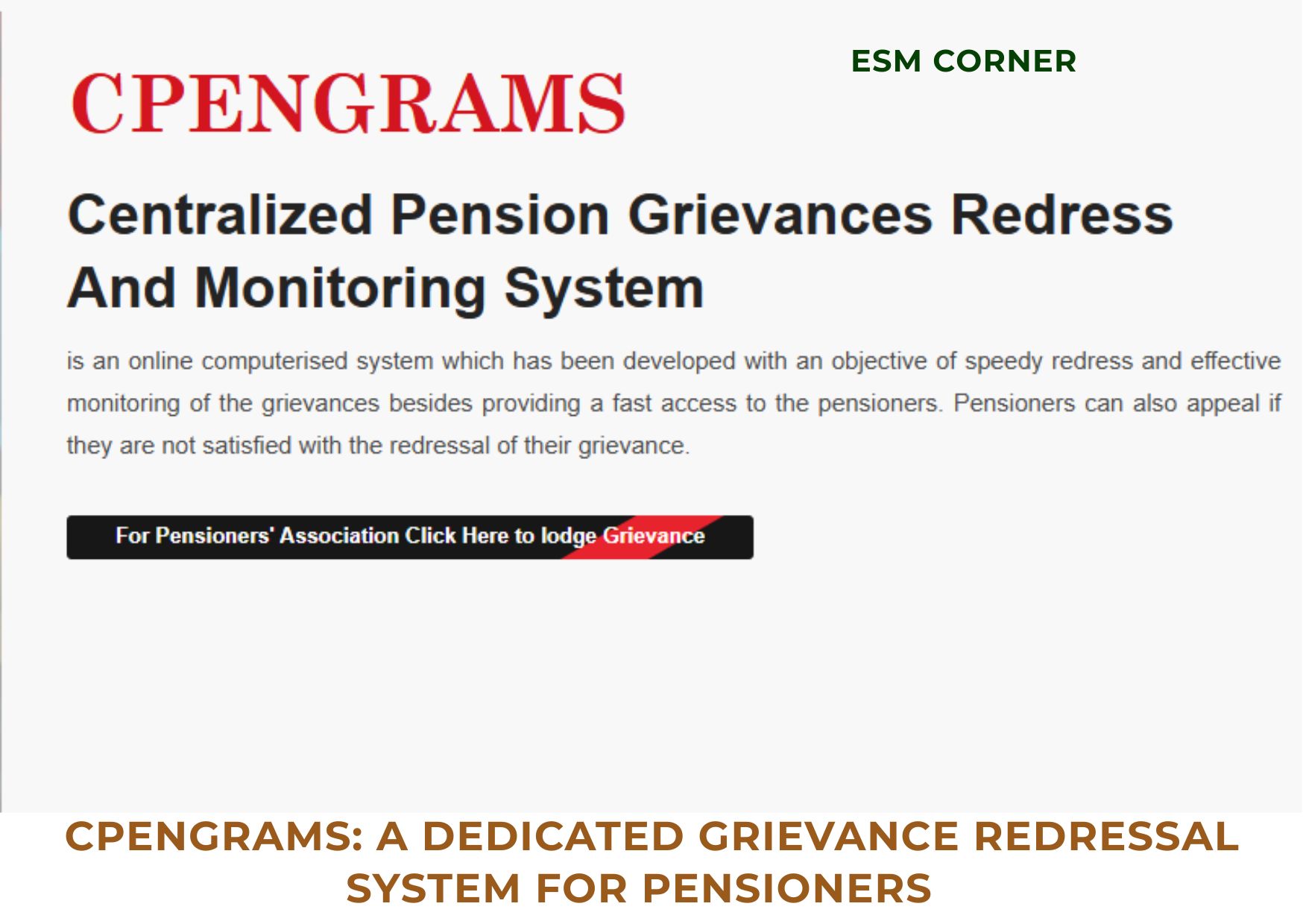
CPGRAMS is designed to handle general public grievances related to Central Government ministries and departments. It covers a wide range of administrative and service-related complaints. - CPENGRAMS (Centralized Pension Grievances Redress and Monitoring System)
CPENGRAMS is designed exclusively for pension-related grievances. It deals only with matters connected to pension, family pension, retirement benefits, and related issues.
👉 Key takeaway:
If the issue is related to pension in any form, CPENGRAMS is the correct platform, not CPGRAMS.
2. Nature and Scope of Grievances
The scope of grievances handled by the two platforms is very different.
CPGRAMS handles:
- Delay in administrative services
- Issues related to government schemes
- Non-response from departments
- Policy-related complaints
- General service delivery failures
CPENGRAMS handles:
- Delay or stoppage of pension
- Wrong fixation of pension
- Non-payment of arrears
- Gratuity and commutation issues
- Family pension and widow cases
- Disability pension issues
- SPARSH-related pension problems
- Errors in PPO or pension revision
👉 CPGRAMS is broad, while CPENGRAMS is deep and specialised.
3. Governing Authority and Monitoring
Another major difference is who monitors and controls these systems.
- CPGRAMS is monitored by the Department of Administrative Reforms & Public Grievances (DARPG).
DARPG handles administrative efficiency across ministries but does not specialise in pension rules. - CPENGRAMS is monitored by the Department of Pension & Pensioners’ Welfare (DoPPW).
DoPPW is the apex authority responsible for framing, interpreting, and implementing pension policies.
👉 This means CPENGRAMS grievances are examined by authorities who actually understand pension rules.
4. Expertise of Officers Handling Complaints
This difference is very important on the ground.
- In CPGRAMS, grievances may be handled by general administrative officers. Pension matters are often forwarded from one office to another, leading to delay or vague replies.
- In CPENGRAMS, grievances are handled by pension-specific desks. Officers are familiar with PPOs, pension calculation, arrears, commutation rules, and defence pension complexities.
👉 This is one of the main reasons why CPENGRAMS gives better outcomes for pensioners.
5. Quality and Depth of Replies
The quality of response often differs significantly.
CPGRAMS replies
- Often generic
- Sometimes procedural
- Frequently end with “matter pertains to another office”
CPENGRAMS replies
- More detailed and rule-based
- Focused on pension regulations
- Address the exact grievance raised
For pensioners, a rule-based reply is far more useful than a routine response.
6. Suitability for Defence Pensioners
Defence pension cases are more complex due to:
- Multiple pension types
- Disability and service elements
- OROP revisions
- SPARSH implementation
- Record Offices and PAOs
- CPGRAMS is not designed to handle these complexities effectively.
- CPENGRAMS is far more suitable for defence pensioners and family pensioners.
👉 For defence pension matters, CPENGRAMS should always be the first choice.

7. Usefulness in Legal and Administrative Escalation
Another practical difference is how useful these platforms are for further escalation.
CPGRAMS
- Useful mainly as a record of grievance
- Limited value in pension litigation
CPENGRAMS
- Creates a strong documentary trail
- Replies are often relied upon in representations, appeals, and tribunals
- Shows that the pensioner exhausted departmental remedies
For pensioners approaching higher authorities or legal forums, CPENGRAMS records are often more meaningful.
8. Monitoring, Escalation, and Reopening
CPGRAMS
- Allows escalation, but monitoring is general
- Pension grievances may get lost among other issues
CPENGRAMS
- Strong monitoring by pension authorities
- Clear options for reopening and appeal
- Better accountability of departments
9. Practical Guidance: Which Platform Should You Use?
Use CPGRAMS if:
- The issue is administrative or service-related
- It does not directly concern pension
Use CPENGRAMS if:
- The issue is related to pension, family pension, arrears, gratuity, or SPARSH
- You are a defence or central government pensioner

Q1. What is the main difference between CPENGRAMS and CPGRAMS?
A1. CPGRAMS is for general public grievances against ministries/departments. CPENGRAMS is only for pension-related grievances like pension delay, arrears, commutation and family pension.
Q2. Which portal should a pensioner use—CPENGRAMS or CPGRAMS?
A2. Pensioners should use CPENGRAMS for any pension issue. CPGRAMS should be used only when the complaint is administrative and not directly related to pension.
Q3. Is CPENGRAMS only for defence pensioners?
A3. No. CPENGRAMS is for all pensioners including defence pensioners, family pensioners/widows and central government civilian pensioners.
Q4. Why does CPENGRAMS work better for pension problems?
A4. CPENGRAMS is monitored by DoPPW and handled by pension-specific officers. Replies are usually rule-based and focused, unlike generic CPGRAMS responses.
Q5. Can SPARSH-related pension issues be filed on CPENGRAMS?
A5. Yes. Pension issues connected to SPARSH such as delays, wrong credit, revision problems or PPO-related discrepancies can be raised on CPENGRAMS.
Q6. What happens if I file a pension complaint on CPGRAMS by mistake?
A6. It may get transferred, delayed, or closed with a general reply. This wastes time, so pensioners should file directly on CPENGRAMS.
Q7. Which department controls CPGRAMS and CPENGRAMS?
A7. CPGRAMS is monitored by DARPG. CPENGRAMS is monitored by DoPPW, which specialises in pension rules and pension policy.
Q8. Can I reopen or escalate complaints on CPENGRAMS?
A8. Yes. CPENGRAMS provides reopening/escalation options and creates a strong documentary record useful for further representation or legal escalation.
Final Takeaway
CPGRAMS is a general grievance platform, while CPENGRAMS is a specialised pension grievance system. For any pension-related issue, CPENGRAMS is the correct, effective, and appropriate platform.
Understanding this difference can save pensioners months of delay and unnecessary frustration.
👉 ALSO READ I 10 MUST-KNOW BENEFITS AND UPDATES FROM THE DIRECTORATE OF CANTEEN SERVICES IN 2026


Why so much time is taken by CPENGRAMS for resolving complaints abd sometimes complaints are closed by vague reply as RESOLVED.No reply is given
Resolving time to be fixed may be 15 days and in case of delay interm reply should be given
Resolving time to be fixed and in case of delay interm reply to be given to petitiomer
please aloow us to down load such Article and copy so as to pass on the matters to thrs. We should be able to copy the article and paste in Micro Officen web and take print out. If already available, pl guide me. Thanking you Sir
Veteran Sgt.S.Kanthiah Exwel Trust 9786449036 ( skanthiah@yahoo.com)
Sir soon you will get all the articles in newsletter format
I am HFO RK Kalra (Retd). I have been guiding retired defence pensioners through different channels for the last fifteen years. I would like to add here that on cpgram and cpengram that even if a person raise an issue on pension related matter on cpgram, system redirect the individual to cpengram.It is quite evident.
Regards