
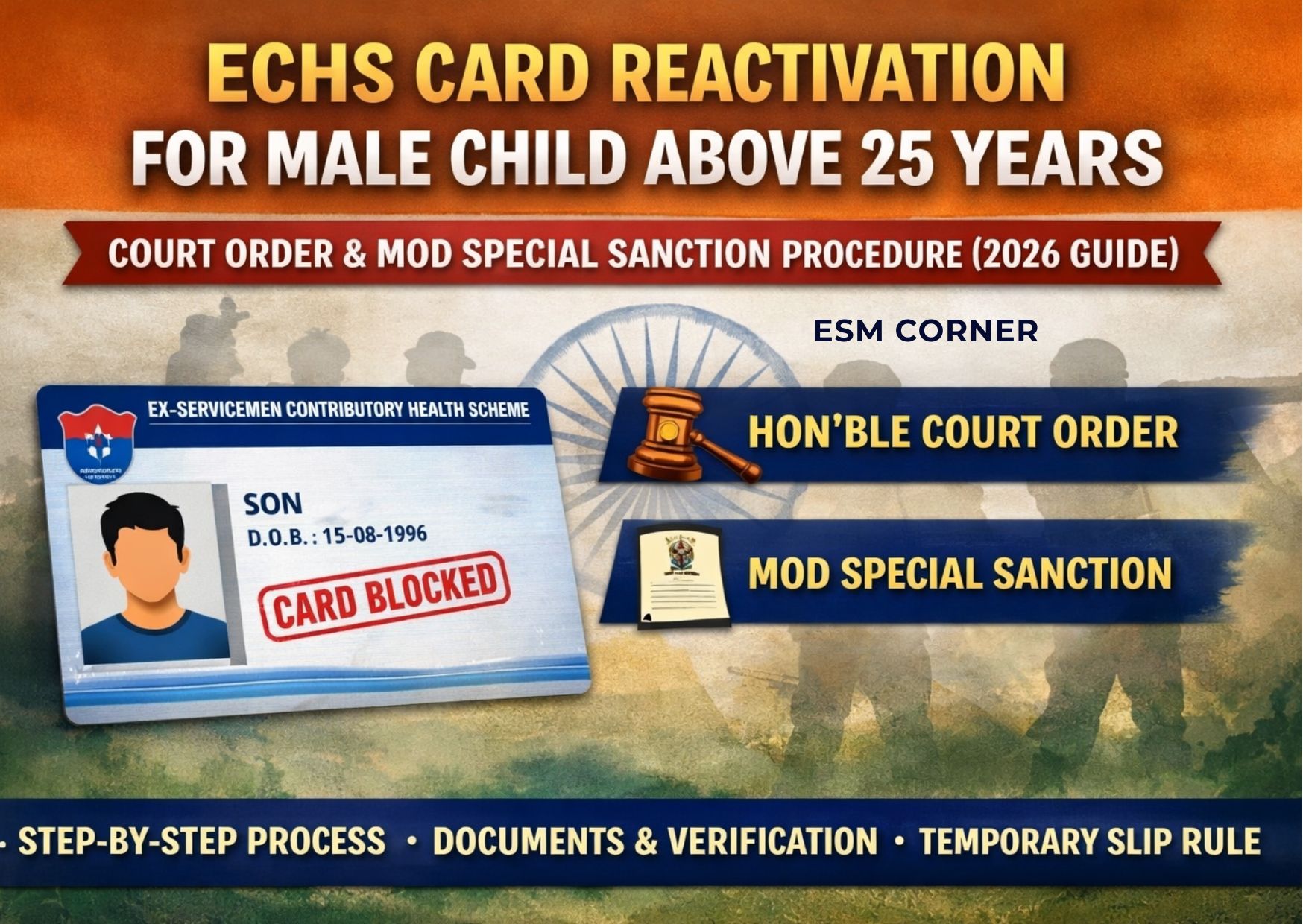
In the ECHS system, dependency eligibility is governed by specific age and status-based rules. Under normal conditions, a male child above 25 years of age is not entitled to ECHS medical facilities as a dependent. This is why, once a male child crosses 25 years, the ECHS system automatically blocks the dependent card.
However, there are certain exceptional circumstances where ECHS benefits may continue even after the age limit. These exceptions apply only when the continuation of medical benefits is supported by legal authority such as a Court Order or a Special Sanction issued by the Ministry of Defence (MoD).
To handle such exceptional cases, Central Organisation ECHS has issued a structured step-by-step procedure to reactivate or restore ECHS card services for male children above 25 years through portal updates, verification, and re-issue.
Why Does the ECHS Card Get Blocked After 25 Years?
ECHS dependency eligibility for male children is generally restricted to the age of 25 years. As soon as this age limit is reached, the dependent status automatically ends in the system and the dependent card is marked as blocked. This is a system-based rule and is not an error.
If the family has a valid legal order or special permission allowing medical benefits to continue, the card can be activated only through a special procedure.
When Can a Male Child Above 25 Years Get ECHS Benefits?
There are only two valid conditions under which reactivation is allowed:
1) Court Order Case
If an Hon’ble Court directs continuation of medical benefits for the dependent male child, the beneficiary can apply for reactivation using the Court Order.
2) MoD Special Sanction Case
If the Ministry of Defence issues a Special Sanction letter permitting continuation of medical benefits, reactivation can be processed using the sanction letter.
Without Court Order or MoD Special Sanction, activation is not permitted after 25 years.
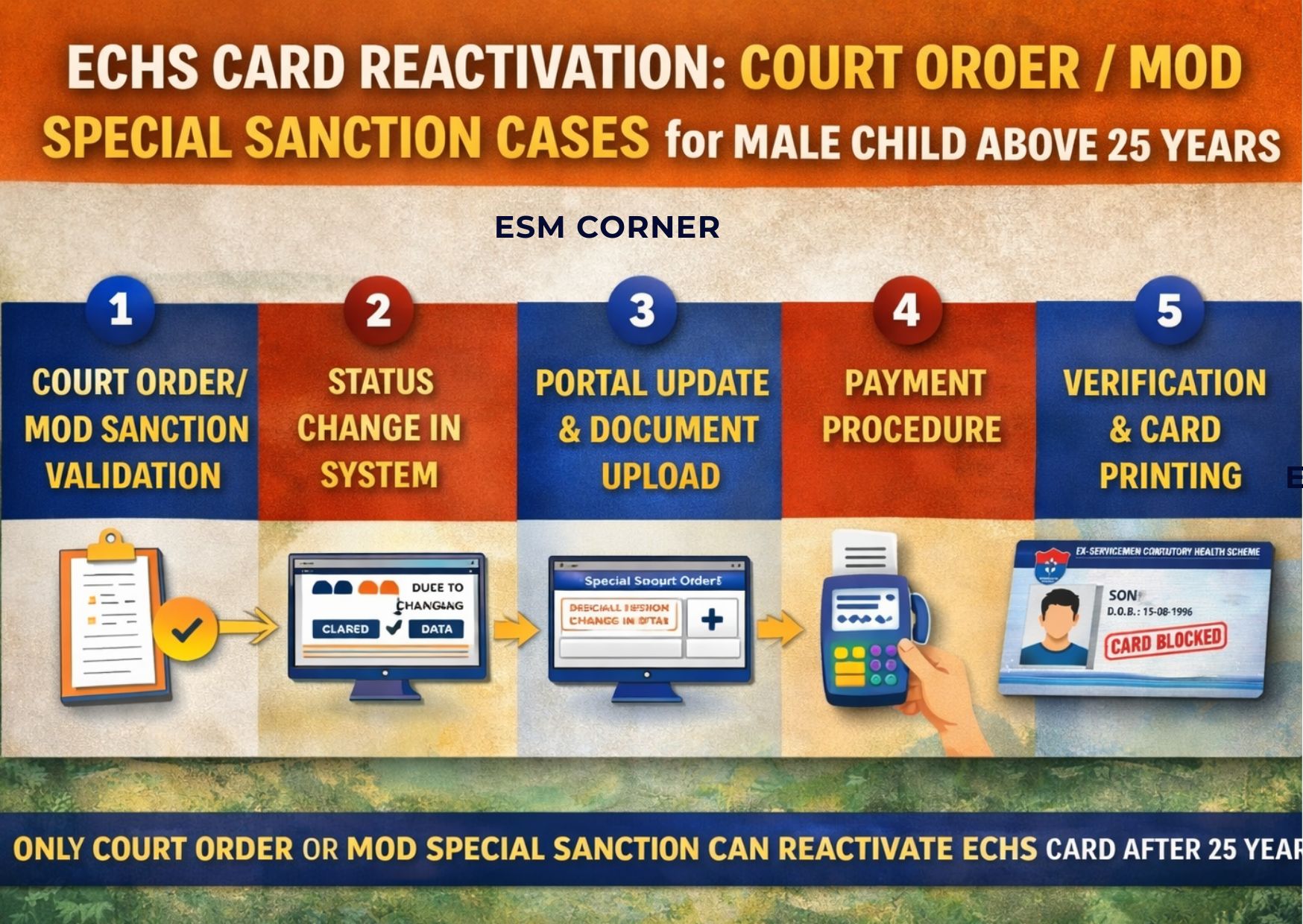
Step-by-Step Procedure (Court Order Cases)
Step 1: Submit Court Order for Validation
The primary beneficiary or ESM must submit a copy of the Court Order to the concerned authority for validation. This step is mandatory, because without validation the portal process will not be enabled.
Step 2: Status Update in the System
After validation, the competent authority instructs the Smart Card printing agency to change the application status in the system:
- from “Card Blocked”
- to “Blocked due to change in Data”
This status change is essential, because it enables the beneficiary to access the “Change in Data” option on the ECHS portal.
Step 3: Use the “Change in Data” Option on ECHS Portal
Once the status is updated, the beneficiary should log in to the ECHS portal and open:
More Options → Change in Data
Select the relevant tick-box and proceed to edit the dependent details.
Step 4: Upload Court Order and Proceed
Under the tab related to Special Sanction / Court Order, the beneficiary must:
- select the Court Order option
- upload the Court Order copy as attachment
- save the application and proceed for payment
Step 5: Verification & Approval
After successful payment:
- the application becomes visible to the concerned Record Office for verification
- after Record Office verification, final verification is conducted by the central ECHS authority
- once approved, the application moves for card printing and issue
Step-by-Step Procedure (MoD Special Sanction Cases)
Step 1: Validation of MoD Special Sanction
In MoD sanction cases, the sanction letter is validated by the competent authority before portal actions can start.
Step 2: System Status Change
After validation, the application status is updated in the same way:
- from “Card Blocked”
- to “Blocked due to change in Data”
The beneficiary is also provided with the MoD sanction details for uploading in the portal.
Step 3: Portal Application and Upload
The beneficiary must log in and go to:
More Options → Change in Data
Then open the Special Sanction section and:
- upload the MoD sanction letter
- save and proceed for payment
Step 4: Verification & Card Issue
After payment:
- Record Office verifies the application
- central verification is completed thereafter
- card is printed and issued after approval
Temporary Slip Rule (Very Important)
During the period when the card is still under processing or printing, the primary beneficiary must:
✅ print a Temporary Slip
✅ get it countersigned by the OIC Polyclinic
This ensures that the dependent can continue receiving medical facilities until the final card is issued.
Practical Tips to Avoid Delay or Rejection
- Reactivation after 25 years is possible only with Court Order or MoD Special Sanction
- Portal editing will not be possible until the application status is changed to “Blocked due to change in Data”
- Uploaded documents must be clear, complete, and readable
- Verification may take time as it involves both Record Office and central approval
- Always keep copies of payment receipt and application submission details
Conclusion
If your dependent male child has crossed 25 years and the ECHS card has been blocked, it is normal as per standard dependency rules. However, if you have a valid Court Order or MoD Special Sanction, the card can be reactivated through a defined procedure involving validation, system status change, portal submission, payment, verification, and printing.
Following the correct steps ensures smooth processing and avoids unnecessary delays, repeated visits to the polyclinic, or rejection due to procedural errors.
How to change your your parent ECHS polyclinic online
👉Do You want to stay updated on post-retirement affairs and welfare news for Indian Armed Forces Veterans click here to join our WhatsApp group
Q1: Can a male child above 25 years get ECHS medical facilities?
A: Normally, No. As per standard ECHS dependency rules, a male child above 25 years is generally not eligible as a dependent. However, benefits may be allowed only in exceptional cases backed by Court Order or MoD Special Sanction.
Q2: Why does the ECHS card of male child get blocked after 25 years?
A: The ECHS system blocks the card automatically once the male child crosses 25 years of age, as per eligibility conditions.
Q3: In which cases can ECHS card be reactivated after 25 years?
A: Reactivation is possible only in two valid cases:
Hon’ble Court Order permitting continuation of benefits
MoD Special Sanction letter authorising continuation of benefits
Q4: What should the beneficiary do first in Court Order cases?
A: The beneficiary/ESM must send the Court Order copy for validation to the concerned legal/claims authority of ECHS (Central Organisation ECHS). Without validation, the portal update cannot move forward.
Q5: What change is done in the system to allow editing of the blocked card?
A: After validation, the authority instructs the card printing agency to change the application status from:
“Card Blocked”
to
“Blocked due to change in Data”
This step enables portal editing.
Q6: Where on the ECHS portal should the beneficiary apply for the change?
A: The beneficiary should log in to the ECHS portal and use:
More Options → Change in Data
Then select the relevant option under:
Special Sanction / Court Order
Q7: What documents need to be uploaded for reactivation?
A: Depending on the case:
Court Order copy (for Court Order cases), OR
MoD Special Sanction letter (for MoD sanction cases)
Documents must be clear, readable, and complete.
Q8: Is payment required for activation through this process?
Q9: Who verifies the application after submission?
A: Verification generally happens in stages:
Concerned Record Office verification
Final approval/verification by Central Organisation ECHS
After verification, the card moves to printing/issue.
Q10: What is a Temporary Slip and why is it important?
A: A Temporary Slip is a provisional document printed by the primary beneficiary. It must be countersigned by OIC Polyclinic so that medical facilities can continue until the final card is printed and issued.











What are the conditions under which a male child of above 25 years of age can be made ECHS beneficiary, please advise. Can a earning unmarried daughter above 25 years of age be made ECHS beneficiary.