
Most defence aspirants know about CDS or AFCAT. But here’s a path that quietly slips under the radar for a lot of graduates: INET — the Indian Navy Entrance Test. It’s a centralised, computer-based route into some genuinely prestigious officer roles across different branches of the Navy.
Here’s a quick heads-up though — recruitment processes can shift over time depending on the Navy’s requirements, so always double-check the latest official notification before applying. That said, let’s break down exactly how INET works and how you can prepare for it.
What Exactly Is INET, and Why Does It Exist?
Think of INET as a single, streamlined gateway into the Navy — instead of applying separately for different technical and non-technical branches, you take one written test and simply state your branch preferences. Clear it, and you move on to the real deal — the SSB interview.
Why did the Navy create this? Simple — to build a transparent, merit-based system for shortlisting graduates. By testing candidates on numerical ability, reasoning, general science, and English, the Navy makes sure only genuinely well-prepared aspirants make it to the interview stage. No guesswork, just solid preparation paying off.
Why Even Consider a Naval Officer Career?
A career as a Naval Officer offers much more than just job security and financial stability. It provides the opportunity to work with advanced military technology, experience global maritime operations, and take on leadership responsibilities from an early stage.
As a Naval Officer, you can be involved in commanding warships, operating with advanced aircraft, or managing complex maritime systems. Along with these challenges, you get the chance to serve the nation by protecting its maritime interests and sea routes.
Which Branch Actually Fits You?
Graduate entry into the Navy is broadly split into four main branches:
- Executive Branch – Covers navigation, gunnery, logistics, naval aviation, intelligence, and overall ship command.
- Engineering Branch – Focuses on marine propulsion, heavy machinery, and hull structures of ships and submarines.
- Electrical Branch – Manages radar systems, missile control, weapons power, and digital warfare technology.
- Education Branch – Handles training programmes, academics, and technical research within naval institutions.
Are You Eligible?
- Educational Qualification – A recognised Bachelor’s degree (B.E./B.Tech, B.Sc, B.Com, MCA, or M.Sc) with at least 60% aggregate marks.
- Marital Status – Must be unmarried.
- Age – Generally between 19 and 24 years at the time the course begins.
Exact requirements vary slightly by branch, so always check the latest official notification for specifics.
How Does the Selection Process Actually Work?
| Stage | Purpose | What’s Tested | Outcome |
|---|---|---|---|
| Written Exam | Screen academic ability | Speed, accuracy, syllabus coverage | Shortlisting for SSB |
| SSB Interview | Assess personality and leadership | Officer Like Qualities | Recommendation status |
| Medical Exam | Verify physical fitness | Health and physical standards | Medical clearance |
| Merit List | Final selection | Combined performance score | All-India Merit Ranking |
| Naval Training | Officer transformation | Discipline, leadership, tactics | Commissioning as Officer |
Let’s Break Down Each Stage
The Written Exam
This is a multiple-choice test covering General English, Reasoning & Numerical Ability, General Science & Mathematical Aptitude, and General Knowledge. Here’s an important detail — you need to clear both the individual section cut-offs and the overall aggregate score, so don’t neglect any one section while prepping for another.
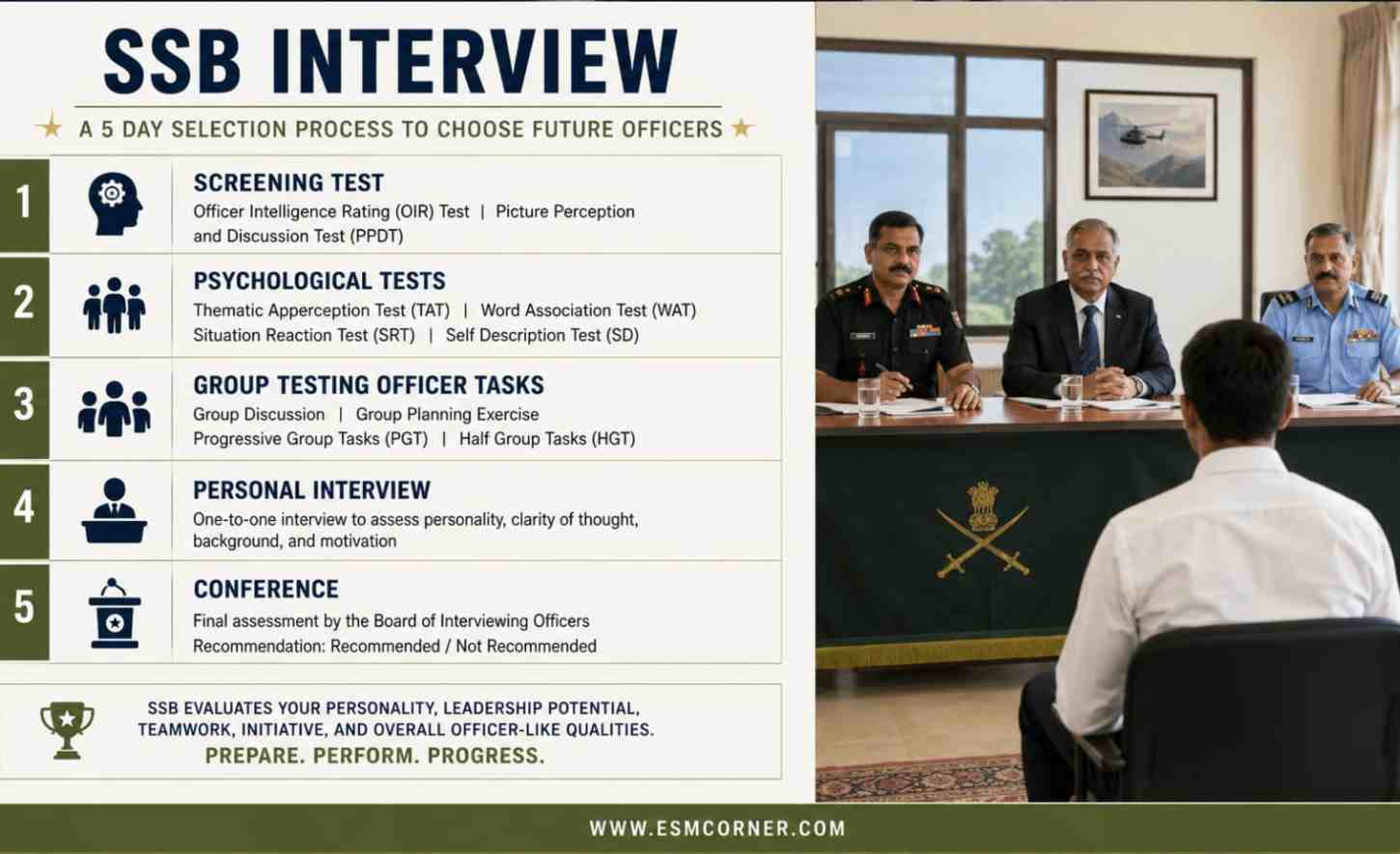
The 5-Day SSB Interview
This is where the real evaluation happens, split into two stages:
- Stage I (Day 1) – A screening round with Intelligence Rating tests and the Picture Perception & Discussion Test.
- Stage II (Days 2-5) – This stage consists of Psychological Tests, Group Testing Officer (GTO) activities, a Personal Interview, and the Final Conference.
Medical Exam and Final Merit List
Once recommended by SSB, you go through a detailed medical examination at a designated military hospital, checking fitness, vision, and overall health. The final merit list combines your written exam and SSB scores, subject to medical clearance and available vacancies.
What Happens Once You’re In?
Selected candidates head to the Indian Naval Academy (INA) in Ezhimala, Kerala, for basic orientation training — a mix of physical training, drills, navigation theory, naval customs, leadership, and actual sailing experience. It’s genuinely intense, and it’s designed to turn civilian graduates into disciplined officers.
Once commissioned, daily life involves quick decision-making, adapting to changing situations, and genuinely looking out for the people under your command. The career ladder typically moves from Sub Lieutenant → Lieutenant → Lieutenant Commander → Commander, with options for either Permanent or Short Service Commission depending on policy and requirements.
How Should You Actually Prepare?
For the Written Exam
Strengthen your basics in maths and general science, build your vocabulary daily, and practice reasoning problems consistently. Regular timed mock tests genuinely help build the speed and accuracy you need to clear the sectional cut-offs comfortably.
For the SSB Interview
Yes, your personality genuinely can be developed for this — but only through real, consistent effort, not last-minute coaching tricks. Focus on staying updated with current events, communicating clearly, taking initiative in group settings, and staying physically active through regular exercise or sports.
What Should You Actually Study?
- Basic high school science and maths textbooks for your foundation.
- Daily newspapers for current affairs, maritime news, and editorial perspectives.
- Standard reasoning and quantitative aptitude practice books.
- The official naval recruitment portal for the latest syllabus and updates.
Mistakes That Trip Up A Lot of Aspirants
- Focusing purely on academic marks while ignoring current affairs and general awareness.
- Preparing for the SSB interview with memorised scripts instead of genuine personal experiences.
- Ignoring physical fitness until after written exam results come out.
- Not checking the latest official notification for changes in eligibility or process.
Conclusion
The INET Graduate Entry represents a premier gateway for motivated young graduates aspiring to serve the nation as commissioned naval officers. Navigating this path successfully demands a balanced approach that combines academic preparation with holistic personality development, physical fitness, and genuine leadership traits.
Rather than relying on temporary trends or outdated coaching advice, candidates should build a strong foundation in core subjects, stay updated on maritime affairs, and cultivate authentic Officer Like Qualities in their daily routines. Always make it a priority to refer to the official Join Indian Navy portal for the latest notifications, eligibility criteria, and entry schemes. If you possess the determination to lead, the discipline to excel, and a passion for the sea, start your preparation today and chart your course toward a distinguished life in uniform.
READ ALSO: ESM CORNER AFCAT ENTRY AFCAT ENTRY EXPLAINED
Frequently Asked Questions
Q1.What is INET?
INET stands for the Indian Navy Entrance Test, an online computer-based examination utilized by the Indian Navy to screen eligible graduate candidates for officer commission across various operational, technical, and administrative branches based on published recruitment notifications.
Q2.Who can apply for INET entry?
Unmarried graduate men and women who meet the specified educational qualifications (typically B.E./B.Tech, B.Sc, B.Com, MCA, or M.Sc with minimum required percentages) and fall within the prescribed age brackets can apply when notifications are published.
Q3.I.s INET conducted every year?
Entry routes and examination schedules are determined by naval administrative requirements; therefore, INET is conducted whenever officially notified by the Indian Navy rather than operating on a guaranteed annual schedule.
Q4.Is the SSB interview compulsory for selection?
Yes, passing the Services Selection Board (SSB) interview is mandatory for all officer entries in the Armed Forces, as it evaluates personality, psychological fitness, and leadership potential.
Q5.Which branches recruit through INET when applicable?
Graduate entries generally cover the Executive Branch, Engineering Branch, Electrical Branch, and Education Branch, subject to specific entry notifications released by the naval headquarters.
Q6.How should graduates prepare for the entrance exam?
Aspirants should focus on foundational mathematics, general science, logical reasoning, English grammar, and current affairs while practicing regular mock tests to build speed and accuracy.
Q7.Is physical fitness important for graduate entries?
Physical fitness is vital because candidates must clear medical boards and endure demanding physical training at the Indian Naval Academy, requiring good endurance, body posture, and stamina.
Q8.What are the long-term career growth opportunities?
Commissioned officers enjoy structured rank promotions, competitive remuneration, specialized technical training, global exposure, high administrative responsibility, and strong post-service career opportunities in leadership roles.
For daily defence updates, government notifications, recruitment alerts, welfare schemes, career opportunities, education news, and other important announcements, join our WhatsApp Community. Click here to join our WhatsApp Group.