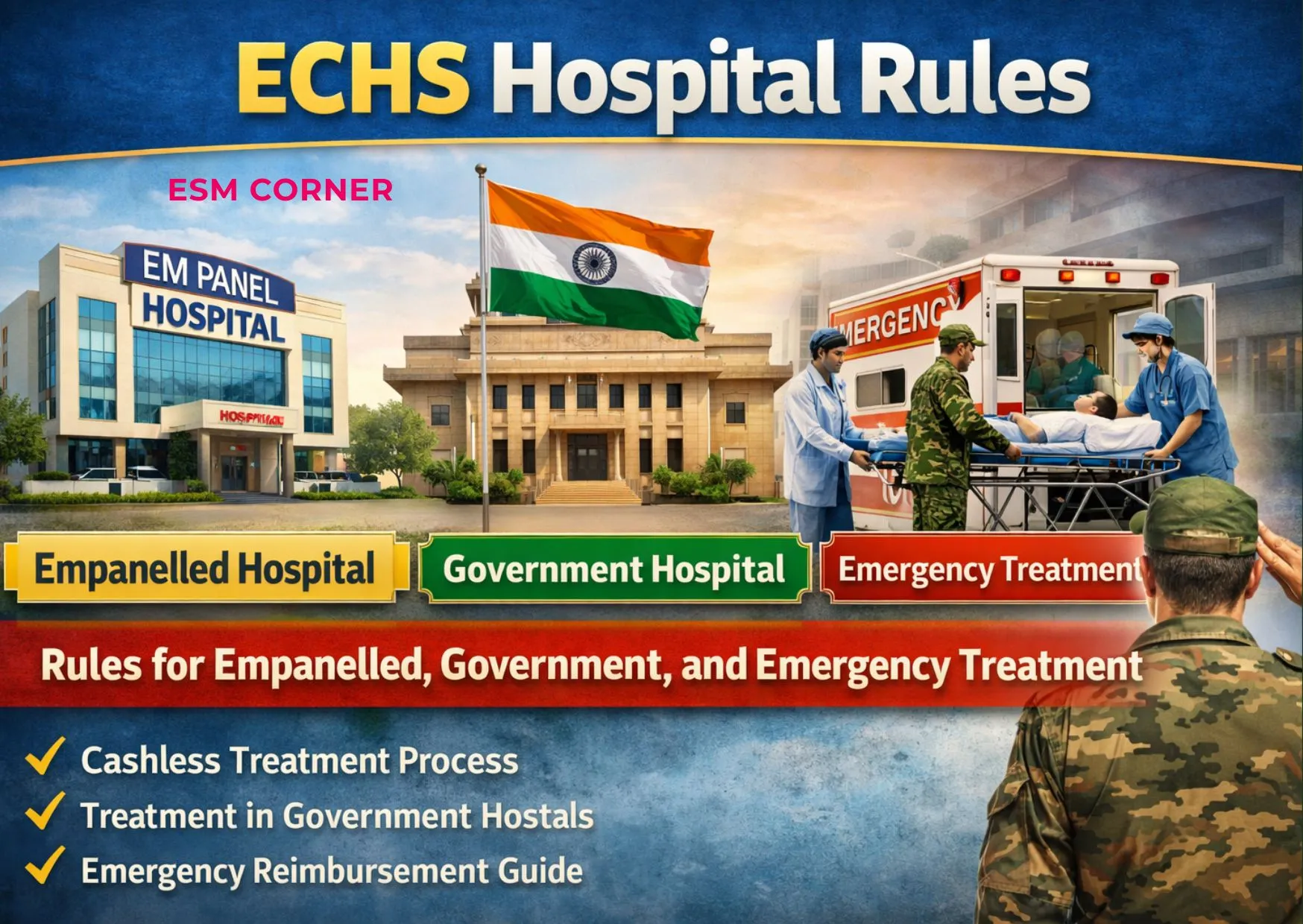
ECHS is a health scheme made for ex-servicemen, their dependents, and eligible family pensioners. It helps them get medical treatment at different hospitals.
Many people are confused about:
- Which hospital they can go to
- When referral is needed
- When they can get money back (reimbursement)
Ex-Servicemen Contributory Health Scheme divides hospitals into four types. You must understand these to take the right decision.
1. Empanelled Hospitals
These are private hospitals that have an official agreement with ECHS.
Best option for planned treatment
They provide cashless treatment
You usually need a referral from ECHS Polyclinic, especially for specialist or admission
2. Government Hospitals
All government hospitals are treated like empanelled hospitals.
These include:
- Government medical colleges
- District hospitals and PHCs
- AIIMS hospitals
- Big hospitals like PGI Chandigarh, Tata Memorial, SGPGI Lucknow
Key points:
- No referral needed
- You can go directly
- Inform Polyclinic later
- Full treatment cost is reimbursed
If tests are not available in the hospital:
- Doctor may advise outside tests
- Cost is reimbursed as per CGHS rates
After treatment:
Submit all documents to Polyclinic
3. Non-Empanelled Hospitals (Emergency Case)
These are private hospitals with no ECHS agreement.
Normally, you should avoid them.
But in emergency:
- You can go to any nearest hospital
- Saving life is the priority
What you must do:
- Inform Polyclinic immediately
- Take Emergency Certificate from hospital
- Keep all bills and reports
Reimbursement:
- Paid as per Ex-Servicemen Contributory Health Scheme rates
After patient becomes stable:
- Shift to empanelled or government hospital
Emergency means:
Serious injury
Accident
Heart attack
Heavy bleeding
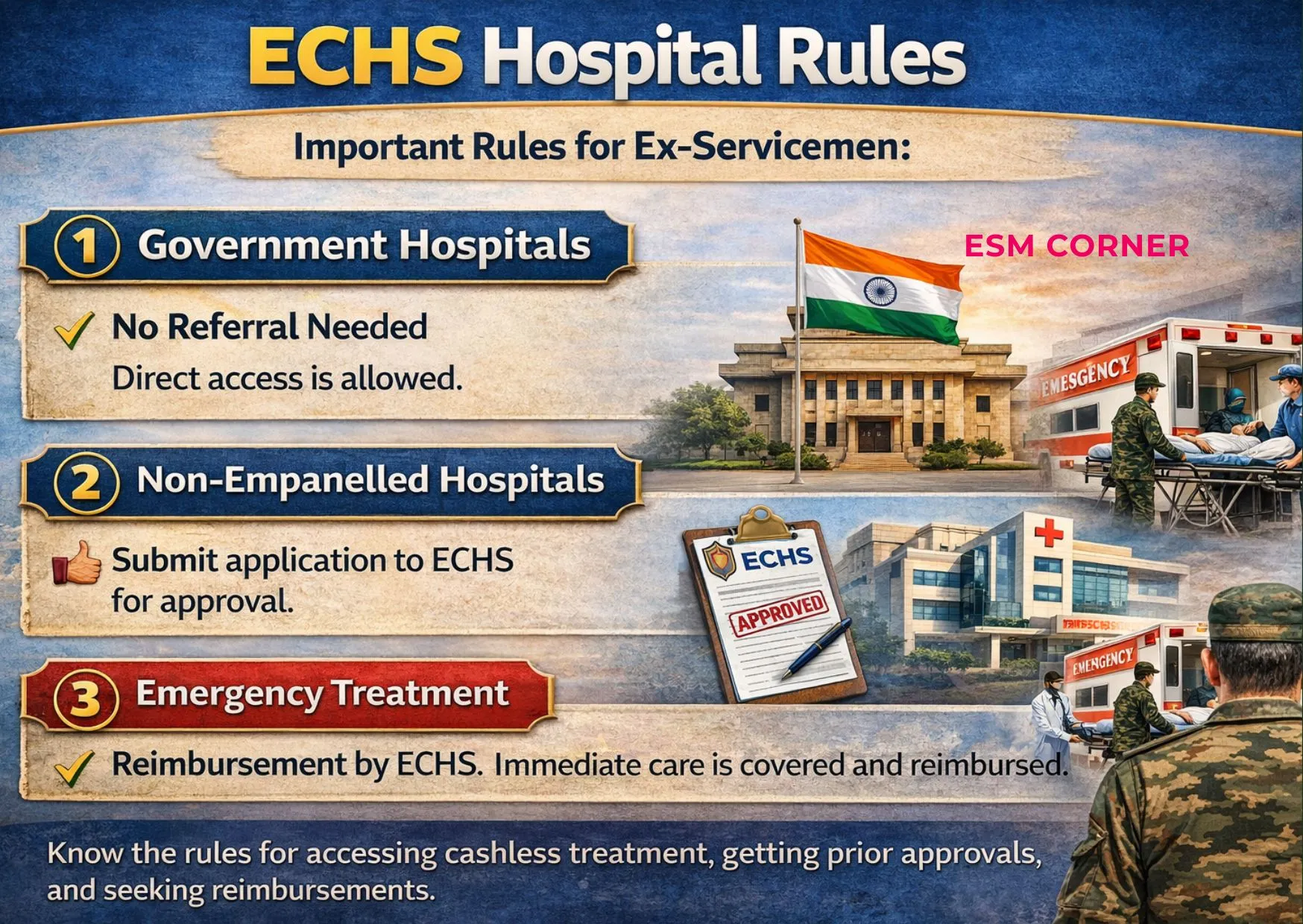
4. Non-Empanelled Hospitals (Normal Case)
If it is not an emergency:
- You must take permission first
Process:
- Submit application to Polyclinic
- Approval goes to CO ECHS
- Treatment allowed only after approval
Important:
Only CGHS/ECHS rates are reimbursed
Full cost is not paid
Conclusion
Ex-Servicemen Contributory Health Scheme is a very important health support system for ex-servicemen and their families.
But:
- Each hospital type has different rules
- You must follow proper process
- Always inform Polyclinic
- Keep all documents safely
Best practice:
Use empanelled or government hospitals whenever possible
Q1: Where is cashless treatment available under Ex-Servicemen Contributory Health Scheme?
A: Cashless treatment is available only in empanelled private hospitals linked with ECHS. Payment is directly settled between hospital and ECHS, but referral from Polyclinic is generally required.
Q2: Is referral required for treatment in government hospitals?
A: No referral is required for treatment in government hospitals. Beneficiaries can directly visit and start treatment, but they must inform the ECHS Polyclinic afterward for proper record and reimbursement processing.
Q3: Which government hospitals are covered under ECHS?
A: All central and state government hospitals are covered, including medical colleges, district hospitals, PHCs, AIIMS, PGI Chandigarh, Tata Memorial, and other nationally recognized government medical institutions.
Q4: What happens if a required test is not available in a government hospital?
A: If a doctor advises tests outside due to unavailability, the cost is reimbursed as per CGHS rates, not actual bill amount. Proper prescription and documents are mandatory for claiming reimbursement.
Q5: Can an ECHS beneficiary go to any hospital during emergency?
A: Yes, in emergency situations, treatment can be taken at any nearest hospital, whether empanelled or not. Immediate medical care is priority, but proper documentation must be maintained for reimbursement.
Q6: How is reimbursement handled in non-empanelled emergency treatment?
A: Reimbursement is not based on actual expenses but limited to ECHS approved rates. All bills, emergency certificate, and treatment records must be submitted to process the claim successfully.
Q7: What should be done after emergency treatment is completed?
A: Once the patient becomes stable, they must be shifted to an empanelled or government hospital as soon as possible, otherwise further expenses may not be fully considered under ECHS rules.
Q8: Can non-empanelled hospitals be used in non-emergency cases?
A: Yes, but only after taking prior approval from ECHS authorities. Without approval, reimbursement may be denied or restricted, even if treatment was medically necessary.
Q9: What is the process to get approval for non-empanelled hospital treatment?
A: A written application must be submitted to ECHS Polyclinic, which forwards it to CO ECHS. Treatment is allowed only after formal approval, otherwise financial risk stays with the patient.
Q10: What is required for reimbursement after treatment?
A: All original bills, prescriptions, discharge summary, investigation reports, and required forms must be submitted at ECHS Polyclinic as per checklist, otherwise claim may be delayed or rejected.