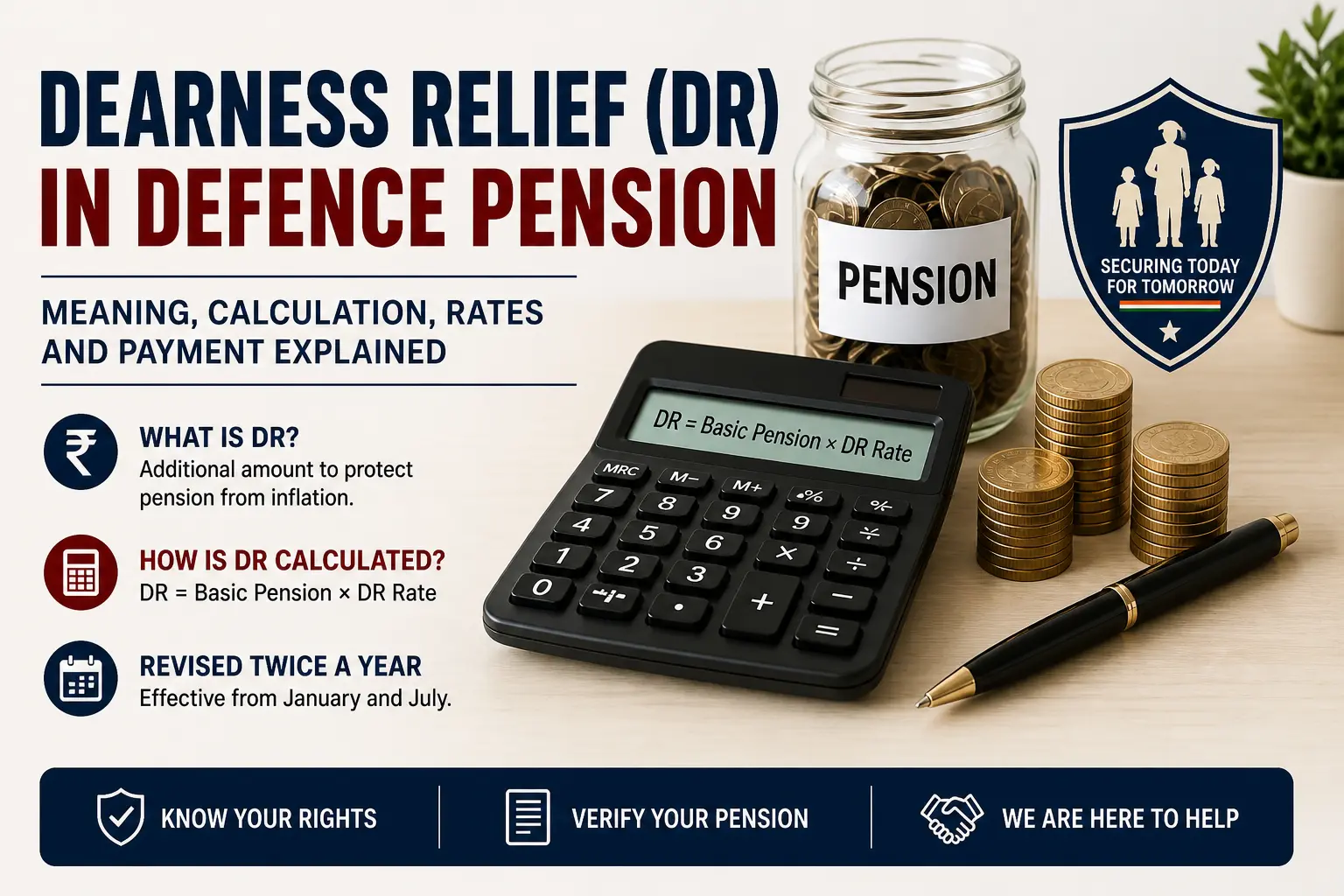
Dearness Relief (DR) is an additional amount paid to defence pensioners to protect them from the impact of inflation. As prices of essential goods and services increase over time, DR helps maintain the purchasing power of pensioners.
In simple terms, DR ensures that the real value of pension does not decrease due to rising living costs. It is applicable to all major categories of defence pension, including:
- Service Pension
- Family Pension
- Disability Pension
- Liberalised Family Pension
- Special Family Pension
DR is not a fixed amount. It is revised periodically by the Government of India based on inflation trends.
Difference Between DA and DR
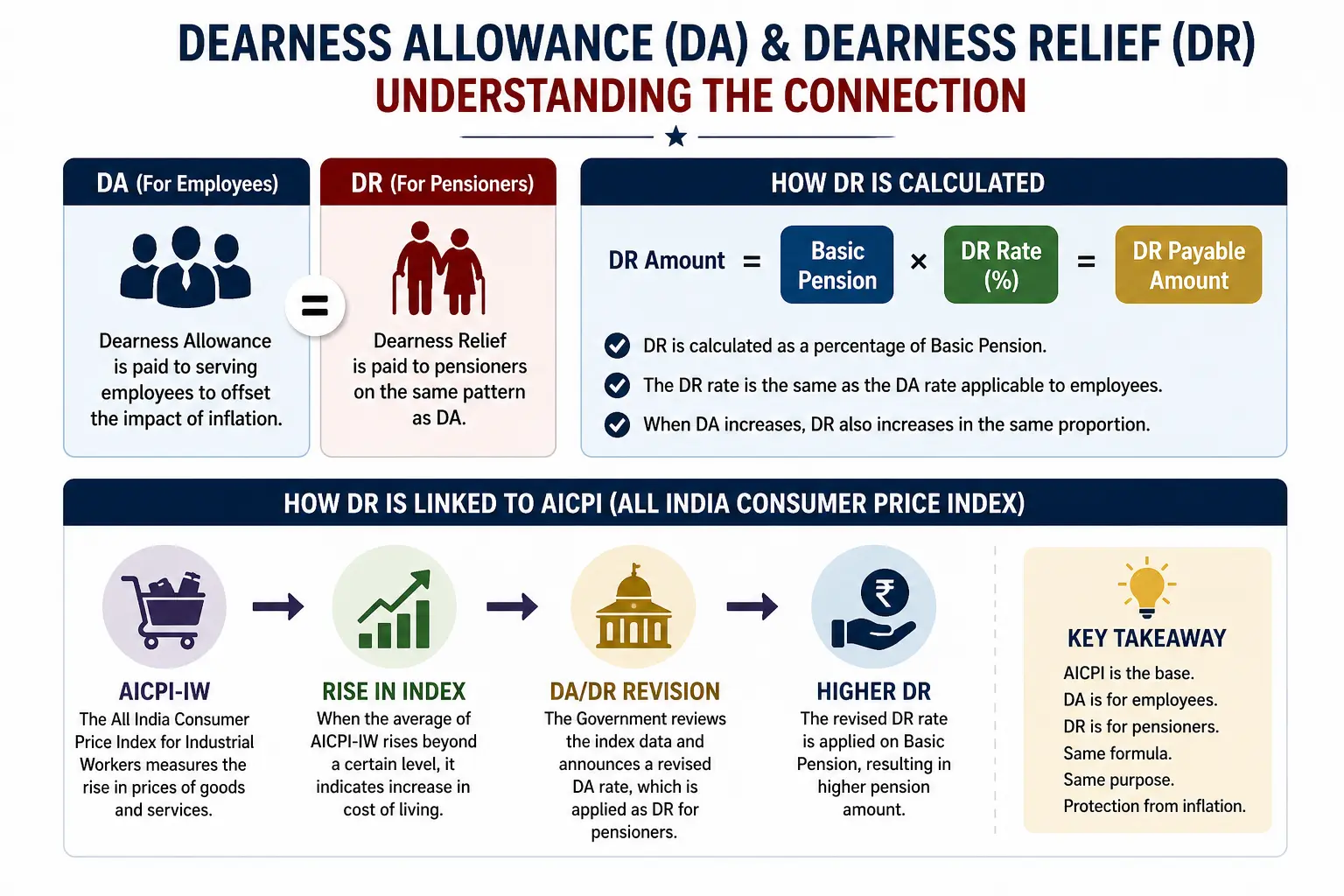
Many pensioners get confused between Dearness Allowance (DA) and Dearness Relief (DR). Both are inflation-compensation mechanisms, but they apply to different categories.
- DA is paid to serving government employees.
- DR is paid to pensioners.
Both are revised at the same rate and at the same time. Whenever the government increases DA for employees, the same percentage is automatically applied as DR for pensioners.
For example:
- If DA becomes 55% for employees, DR also becomes 55% for pensioners.
DA is calculated on basic pay, whereas DR is calculated on basic pension.
Role of AICPI in DR Calculation
DR revisions are based on the All India Consumer Price Index for Industrial Workers (AICPI-IW). This index measures inflation by tracking changes in the prices of essential commodities and services.
When the AICPI index rises, it indicates an increase in inflation. Based on this increase, the government revises DA and DR rates.
In simple language:
- AICPI measures inflation
- DA compensates serving employees
- DR compensates pensioners
Without AICPI data, there would be no scientific basis for revising DR rates.
Why Dearness Relief Is Important
Basic pension generally remains fixed unless a major pension revision or Pay Commission change occurs. However, daily expenses continue to increase. DR helps bridge this gap.
Importance of DR
- Maintains purchasing power of pensioners
- Protects pension from inflation
- Provides regular financial relief without changing basic pension
- Increases total monthly pension automatically after every revision
For many pensioners, DR forms a significant portion of total pension income.
How Dearness Relief Is Calculated
DR is calculated as a percentage of the basic pension.
Formula
DR Amount = Basic Pension × Applicable DR Rate (%)
Example
- Basic Pension: ₹30,000
- DR Rate: 55%
DR Amount = ₹30,000 × 55% = ₹16,500
Total Pension = ₹46,500
As DR rates increase, the total pension payable also increases proportionately.
DR Revision System
Dearness Relief is revised periodically by the Central Government based on inflation trends.
Key Points
- DR rates are announced by the Government of India
- Revised twice every year
- Effective from 1 January
- Effective from 1 July
- Applicable uniformly to eligible central government pensioners and defence pensioners
Any increase in DR directly increases monthly pension.
👉 Check your latest DR amount instantly with our DA calculator
How DR Is Paid
DR is paid automatically along with monthly pension. Pensioners do not need to submit any separate application.
Payment Process
- Added automatically to monthly pension
- Credited directly to bank account
- Arrears paid automatically after revision, if delayed
If a DR revision is implemented late, the pending amount is generally credited as arrears.
Dearness Relief and Pension Commutation
This is one of the most misunderstood areas among pensioners.
Many believe that DR is calculated only on the reduced pension after commutation. This is incorrect.
Correct Rule
DR is always calculated on the original basic pension, not on the reduced pension after commutation.
This ensures that pensioners continue receiving full inflation protection even after commuting a portion of their pension.
Situations Where DR May Not Be Payable
In certain exceptional cases, DR may be stopped or withheld.
Examples
- Pension is suspended or discontinued
- Certain re-employment conditions under government rules apply
- Violation or non-compliance of pension regulations
However, these are exceptional situations and do not apply to normal pension cases.
Common Problems Related to DR
Most DR-related issues occur because of administrative delays, software updates, or PPO mismatches.
Common Issues
- Revised DR not applied on time
- Incorrect pension calculation
- Arrears not credited properly
- PPO data mismatch affecting DR component
- Bank delay in updating revised DR rates
Such problems usually require verification with the bank, SPARSH, PCDA, or pension authority concerned.
Final Understanding
Dearness Relief is not a bonus or special incentive. It is a structured inflation-adjustment mechanism designed to protect pensioners from rising living costs.
As inflation increases, DR ensures that defence pensioners continue receiving reasonable financial support without erosion of pension value.
Understanding DR helps pensioners:
- Verify pension correctly
- Identify calculation errors
- Understand pension increases
- Track DR revisions and arrears properly
A clear understanding of DR prevents unnecessary confusion regarding monthly pension changes and entitlement calculations.
Q1: What is Dearness Relief (DR) in defence pension?
A: Dearness Relief is an additional amount paid to defence pensioners to offset inflation. It helps maintain the real value of pension by adjusting income in line with rising cost of living over time.
Q2: How is Dearness Relief calculated?
A: Dearness Relief ,DR is calculated as a percentage of the basic pension. The government announces the rate, and the amount is automatically added to the monthly pension based on that percentage.
Q3: How often is DR revised?
A: DR is typically revised twice a year, effective from January and July. The revision depends on inflation trends and government decisions, and the updated rate applies to all eligible pensioners.
Q4: Do I need to apply separately to receive DR?
A: No, DR is automatically added to your pension. Once the government announces a revised rate, it is implemented in your pension without any application from your side.
Q5: Is Dearness Relief calculated on reduced pension after commutation?
A: No, DR is always calculated on the full basic pension amount, not on the reduced pension after commutation. This ensures pensioners continue to receive full inflation adjustment.
Q6: Does Dearness Relief apply to all types of defence pensions?
A: Yes, Dearness Relief applies uniformly to service pension, family pension, and disability pension. It is a common benefit provided across all pension categories.
Q7: Can DR be stopped in any situation?
A: Yes, DR may not be payable in specific cases such as pension suspension or certain re-employment conditions. However, such situations are limited and depend on applicable rules.
Q8: What should I do if Dearness Relief ,DR is not credited correctly?
A: You should first verify your pension slip and Dearness Relief rate. If there is a mismatch, raise a grievance through SPARSH or contact the concerned authority for correction.